
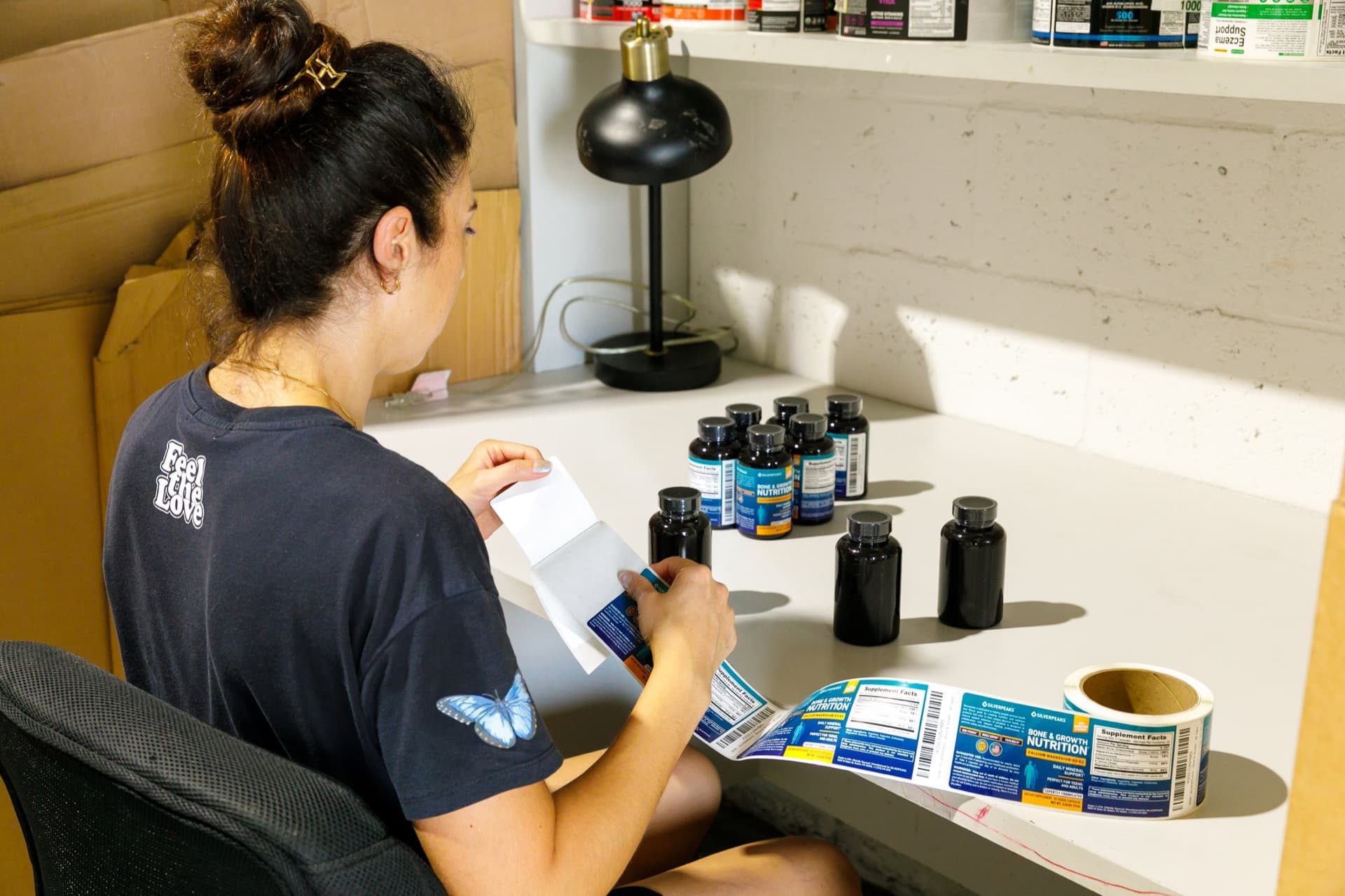
Labels are the cheapest thing on the pallet and the most expensive to get wrong
Every problem we see at Amazon receive comes down to one of five label issues. None of them are about the product — all of them are about the sticker on top of it.
At SunPort Prep Center, our 2,500 sq ft warehouse in Dania Beach sits close enough to the South Florida fulfillment centers that we get fast feedback when a shipment hits a snag. Almost every "unscannable" or "unprepped" flag traces back to the same handful of label mistakes. The good news: all five are preventable on the table before a unit ever goes into a box. Here is what holds shipments at the FC, the spec each mistake violates, and how we fix it on the floor.
1. Barcode density that won't scan
The most common silent killer. An FNSKU is a Code 128 barcode, and Code 128 needs crisp, high-contrast bars at full size to scan reliably. The trouble starts when sellers print the PDF from Seller Central with "fit to page" or "shrink to fit" checked, or run it on a low-resolution inkjet. The bars blur together, the quiet zone (the blank margin around the barcode) gets eaten, and the FC scanner chokes.
The spec it violates: Amazon expects a clean, undistorted barcode printed at actual size with enough resolution that every bar is distinct. Scaled-down or low-DPI prints fail that.
The fix: Print at 100% — scale set to "actual size," never "fit." Use a thermal label printer rather than inkjet; thermal gives sharp black bars and never smears wet ink across the code. And scan-test. We pass a handheld scanner over a sample from every batch before it goes into production. If it does not beep on the first pass at a normal angle, we reprint.
2. Label-on-label, or a manufacturer barcode left exposed
Amazon needs exactly one scannable barcode on the unit: yours. If the factory UPC or EAN is still visible next to your FNSKU, the receiving scanner can grab the wrong one. That is how units get commingled with another seller's stock — a real inventory and authenticity risk. The opposite mistake is stacking your FNSKU directly on top of an old, peeling label, so it lifts off as one chunk.
The spec it violates: Each unit must show a single readable barcode. Any other product barcode has to be fully covered.
The fix: Two steps, in order. First, cover the existing manufacturer barcode completely — either a blank cover-up label or your FNSKU placed squarely over it so no bars peek out at the edges. Second, apply the FNSKU to a flat, clean spot. Do not layer onto a label that is already lifting; remove or smooth it first so your sticker bonds to the packaging, not to loose adhesive.
3. Missing or undersized suffocation warning
Any unit in a poly bag with an opening of roughly five inches or more needs a suffocation warning printed on it or on a sticker, and the text has to be legible. Sellers forget this constantly, or they use a tiny font that the receiver rejects. A bag that fails this check can hold the whole shipment.
The spec it violates: Poly-bagged units at or above the size threshold require a clearly readable suffocation warning, sized so it is easy to read at arm's length.
The fix: If the bag is at or near that opening size, it gets a warning — no judgment calls. We keep pre-printed warning labels at the bagging station, and where the bag is large we use bags with the warning printed directly on the film. When in doubt, add it; an extra warning never fails a check-in, a missing one does.
4. Placement on a curve, seam, edge, or corner
A barcode only scans flat. Wrap it around the corner of a box, lay it across a poly-bag seam, or stick it on a curved bottle or jar and the bars distort under the scanner — even though the print itself is perfect. This one frustrates sellers because the label looks fine to the eye.
The spec it violates: The barcode must lie flat and unbroken on a single surface so the scan beam reads it in one continuous pass.
The fix: Choose the flattest available face. Keep the whole barcode, plus its quiet-zone margin, on one panel — never bending over an edge or bridging a seam. On round packaging, place the label where the curve is gentlest and orient the bars along the length of the curve, not around it, so they stay parallel and readable.
5. Smudged or peeling labels
A label that scans on your bench but arrives smeared or curling at the FC is a wasted print. Inkjet ink smudges with handling and humidity — and South Florida humidity is no joke. Standard paper labels also refuse to stick to cold, frosty, glossy, or textured packaging, so corners lift in transit and the barcode tears.
The spec it violates: The label must stay intact, adhered, and scannable through shipping and receiving — not just at the moment you print it.
The fix: Use thermal labels with permanent adhesive on the right stock for the surface. Thermal print does not run when it gets damp. For cold-chain or frozen items, use freezer-grade adhesive rated to bond on cold surfaces; for glossy or textured packaging, press the label down firmly across its whole area so it grips. Apply to a clean, dry, room-temperature surface whenever you can.
Pre-ship label QA checklist
Before any unit leaves the table, we run it against this:
- Barcode printed at 100% scale on a thermal printer, bars crisp with a clear quiet zone
- A sample from the batch scan-tested and beeping on the first pass
- Exactly one barcode visible — every manufacturer UPC or EAN fully covered
- FNSKU on a flat, clean surface, not layered over a lifting label
- Suffocation warning present and legible on every qualifying poly bag
- Label on a flat panel, not wrapped over a corner, seam, or curve
- Adhesive matched to the surface (freezer-grade for cold, firm-pressed for glossy)
- Label flat, fully stuck down, no smudging or lifting corners
Get these eight right and your shipments check in clean. If you would rather hand the labeling off entirely and never think about barcode density again, contact us — we will prep, label, and scan-test every unit before it ships.